Search for a Semrush alternative in October 2026 and you get roughly the 2023 list: Ahrefs, SE Ranking, Mangools, Moz, Serpstat. The difference is that none of them are selling the same thing anymore.
The SEO suite used to be a database subscription. You paid per seat, you got a keyword index, a backlink index and a crawler, and the main argument was whose index was fresher. This year the unit of sale changed. Semrush’s entry plan is about $199 a month and includes prompt tracking. Ahrefs prices AI visibility separately, by the check. Moz bundles a fixed number of tracked prompts into every tier. The question is no longer whose index is bigger, but how many answers you need to watch and who counts them.
What actually changed in the last twelve months
The biggest structural change is ownership. Adobe completed its acquisition of Semrush on 28 April 2026, and the company now issues announcements as “Semrush, an Adobe Company” (Semrush newsroom). By 17 June it had shipped Adobe Brand Visibility, combining Semrush’s AI visibility data with Adobe’s content tooling. A Gartner Market Guide for answer engine visibility tools followed in July, listing Semrush among representative vendors. That is a budget signal: AI visibility now sits next to content operations, not rank tracking.
Pricing moved with it: Semrush no longer quotes a single Pro price. Its plan comparison published 21 October 2026 lists Starter at $199/month, or $165.17 on annual billing, and Pro+ at $299/month, or $248.17 annual. That buys five or fifteen projects, 500 or 1,500 tracked keywords, and 50 or 100 tracked AI prompts a day. Brand Performance covers one brand; each additional brand is $99/month on either plan, and an extra user starts at $45/month. The $139.95 Pro plan that most “Semrush alternative” posts were written against is gone.
Ahrefs went the other way and made the meter explicit. Lite, Standard and Advanced are still $129, $249 and $449 a month, but every user now comes with a credit allowance — 1,000 credits on Lite, unlimited on the upper tiers. Brand Radar, its AI visibility product, is sold separately from about $199/month, or as prompt packages: $50/month for 2,500 checks, $100 for 7,000, $250 for 25,000, with overage at $0.02, $0.015 and $0.01 per check (ahrefs.com/pricing, checked 23 October 2026). One check is one prompt on one platform in one location. That sentence is the pricing model, and buyers keep missing it.
The cheaper end followed. Moz’s Pro tiers now include 150, 300 or 600 tracked prompts with weekly refresh, from about $79/month on annual billing (moz.com). SE Ranking rebuilt its plans around “SEO + GEO”, with 100 prompts a day on its $129 Core plan and a separate SE Visible product for teams that only want AI visibility (seranking.com). Mangools starts around $38/month on annual billing and does not track prompts.
Two product moves matter for workflow more than price. Semrush shipped an official Claude connector on 26 August 2026, with MCP access on Starter; Ahrefs lists an MCP server on every paid tier. The dashboard is becoming optional; the API quota is becoming the product.
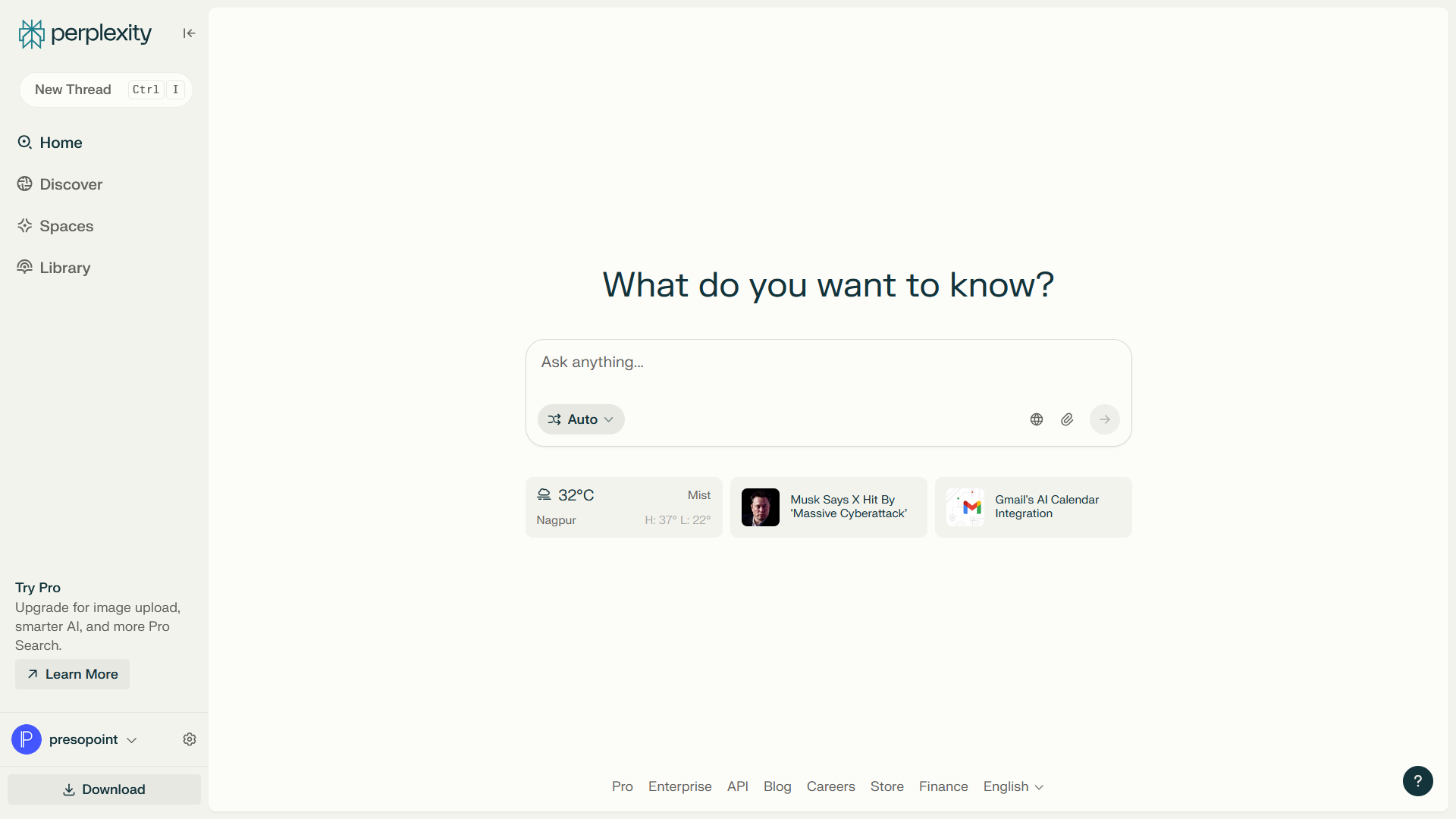
Perplexity’s homepage. Answer engines like this are now a tracked channel inside SEO suites — screenshot from perplexity.ai.
What you can still do, and who does it best
Keyword research is the commodity
Keyword data has been good enough for years. Ahrefs and Semrush both return volumes, difficulty and SERP history a content team can act on; the differences show up in localisation and in how fast new terms appear. What changed is how you pay for bulk pulls. Ahrefs’ per-user credit allowance means a scripted export of 200,000 rows is a budgeting decision, not a click. SE Ranking advertises unlimited keyword research on Core at $129 list, which is why agencies with high research volume keep it around. Mangools is the cheapest credible option for pure keyword work; its smaller index and one-region lookups on lower tiers are why.
Backlinks are still Ahrefs’ argument
If link building is the job, the decision is still mostly Ahrefs. Its index is the one other tools are measured against, and Lite at $129 is enough for one site’s prospecting. Semrush’s Backlink Analytics is close enough that nobody should switch for that alone. SE Ranking’s module is serviceable at a third of the price if you are checking a client profile rather than running outreach at scale. Mangools aggregates third-party link data and should not be your primary source. The honest test: pull ten referring domains for a site you know and see which tool finds the links competitors actually earned.
Site audits are priced by pages, not by brand
Every suite has a crawler, so the differentiator is crawl volume and what happens afterwards. SE Ranking includes 250,000 audited pages a month on Core and 2 million on Growth. Ahrefs meters crawl credits — 500,000 on Lite, 1.5 million on Standard — and charges $20/month per project for a 1,000-URL recrawl add-on, or $200 for unlimited URLs. Semrush’s Site Audit is the most opinionated of the three and now includes an “AI-ready” check that flags content structures LLMs parse badly. For a 2,000-page site, all are fine. For a marketplace with half a million pages, the crawl bill decides.
AI visibility is the new column, and the numbers are not comparable
This is where the category is unsettled. Semrush tracks prompts daily, reports brand sentiment and caps AI visibility reports at 300 a day on Starter. Ahrefs sells prompt checks against a database it describes as 493 million organic prompts. Moz refreshes weekly. SE Visible is a separate subscription. None of them measure the same thing: one counts mentions, another citations, another share of answers, and the prompt sets differ. Semrush’s own AI Visibility Index — expanded to 126 million US prompts in June 2026, with a UK benchmark added in October — found that visibility on one platform does not predict visibility on another, and that UK and US results diverge sharply. That is a warning against treating any single “AI visibility score” as a KPI.
For most teams, weekly tracking of 50 to 100 prompts is enough; daily tracking is a feature you will open twice. AI referrals also arrive with messy attribution — the reconciliation problem described in our Google Analytics alternative guide.
Where this is going, and what is guesswork
Three predictions, labelled as such.
Consolidation into marketing clouds. Adobe bought Semrush. The next acquisition in this category is more likely to be an AI visibility specialist than another keyword database. If procurement already runs through Adobe or a similar stack, bundling will beat feature comparisons.
Consumption pricing becomes normal. Prompt checks, crawl credits and user credits all push cost onto usage. Expect renewal quotes that look flat and invoices that do not. Ask for the overage rate in writing before signing.
The dashboard loses importance. With MCP servers on both Semrush and Ahrefs, the plausible 2027 workflow is an agent querying the API and writing the report. If that happens, seat count matters less and API quota more — bad news for teams that bought ten seats to get ten logins.
What is not speculation: tracking an answer means repeated queries across platforms and locations, and that cost is landing on the prompt check.
Who should switch, and to what
Solo consultant, one to three sites, keyword-led work. Mangools at about $38/month annual. You give up prompt tracking and serious backlink data, and you save roughly $1,900 a year against Semrush Starter.
Small agency, five to fifteen clients, reports that include AI answers. SE Ranking Growth at about $279/month, or Semrush Pro+ at $299 if clients ask for brand sentiment and a recognisable logo. Check the extra-brand fee first: $99/month per brand changes the maths for a ten-client agency.
In-house team already inside Adobe. Semrush is the path of least resistance, and the Claude connector plus MCP access are real wins if your team works in chat.
Link building is the core service. Ahrefs Lite, and add Brand Radar only when a client pays for AI visibility reporting.
AI visibility is the entire deliverable. A standalone tracker plus the cheapest SEO tool that covers audits. Buying a $299 suite and using 40 of its 100 prompts is the most common waste here.
Already on Semrush and renewing. Do not migrate in a panic: the connector, App Center additions and UK index all landed after the acquisition. Get the quote, compare it with SE Ranking’s, and negotiate. Ranking history does not transfer, so export it first. If SEO is one of five jobs on your desk, the wider stack matters more; our AI tools for business guide covers that trade-off.
FAQ
Is Semrush still worth it after the Adobe acquisition?
The product is being developed, not frozen: the connector, App Center additions and expanded index all shipped after the deal closed. The question is price, not viability. At about $199/month, Starter sits well above the old Pro entry, so the case depends on whether you use prompt tracking and brand sentiment. If you only need keywords and backlinks, you are paying for capability you will not open.
What is the cheapest real alternative to Semrush?
Mangools at about $38/month on annual billing for keyword research, or SE Ranking Core at about $129/month if you need audits and prompt tracking in one place. Free stacks — Google Search Console, Bing Webmaster Tools, Ahrefs Webmaster Tools — cover indexing and basic link data, but not competitor research or prompt monitoring.
Do I need a separate AI visibility tool?
Only if AI answers are a reported deliverable. Every major suite now includes some prompt tracking, and the scores are not comparable across vendors. Define 30 to 50 real buyer prompts, track them weekly for a quarter in the suite you already pay for, then decide. Dedicated trackers are priced per prompt and usually cheaper than a tier upgrade. If traffic arrives and does not convert, a form builder comparison moves revenue faster than another rank tracker.
Can I keep my historical data when I switch?
Export what you can: rank tracking CSVs, backlink lists, audit history. Rank history does not transfer between vendors, so plan a two-month overlap with both tools running: one month of double subscription beats explaining a flat trend line to a client.
Sources: Semrush newsroom (Adobe acquisition, 28 April 2026; Adobe Brand Visibility, 17 June 2026; Gartner Market Guide, 7 July 2026; Claude connector, 26 August 2026; AI Visibility Index UK benchmark, 13 October 2026); Semrush plan comparison, 21 October 2026; semrush.com/pricing, ahrefs.com/pricing, moz.com/products/pro/pricing, seranking.com/pricing.html and mangools.com, all checked 23 October 2026. Prices are list prices and change — check official sites before buying.