Bottom line: Perplexity is still the best tool when you need answers with sources. ChatGPT has closed most of the gap and wins on depth and follow-up conversation. Gemini wins if you live inside Google. None of them are bad in 2026, so the choice comes down to how you ask questions.
AI search went from a novelty to a default in about two years. Everyone uses an AI assistant for questions now, and the interesting question is no longer whether AI search works. It is which one works for your kind of searching.
This comparison gets asked constantly, and most answers are tribal.
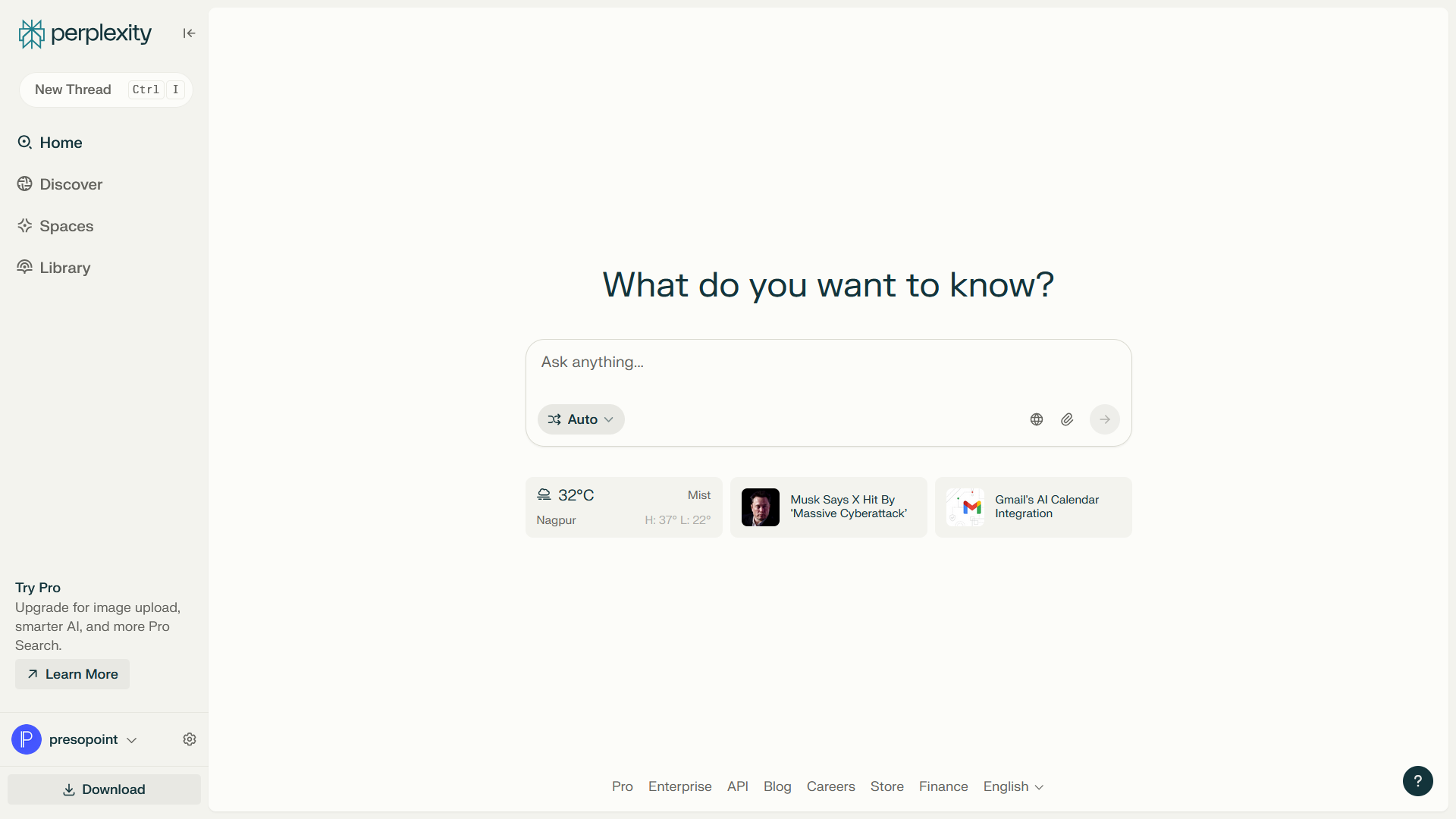
Official image from the Perplexity website. Perplexity users insist citations matter. ChatGPT users insist depth matters. Gemini users insist integration matters. All three are right, which is why the honest answer depends on what you actually do. This guide walks through the real differences and helps you pick, or tells you honestly when rotating between them makes sense.
What changed by late August 2026
All three tools shipped meaningful updates since this comparison first ran, and the official pages as of late August 2026 look like this:
- ChatGPT reorganized its plans. OpenAI now sells Free, Go, Plus, and Pro tiers, and the current model generation is GPT-5.6 — Luna serves the free tier, while the reasoning-heavy Sol models sit on paid plans (openai.com/chatgpt/pricing). The free tier is still generous: unlimited text chats, with limits on uploads, image generation, voice, and deep research. Search stays built into the assistant on every tier, so the core trade-off is unchanged: you get depth and follow-up conversation rather than citation-first answers.
- Perplexity doubled down on subscription-first. After dropping AI-integrated ads in February 2026, Perplexity now treats the paid plan as the real product — the free tier is limited to a small number of pro searches per day on the base model (perplexity.ai/pricing). The company also pushed its Comet browser, free to download with an Android build, as the agentic way to use Perplexity beyond the search box (perplexity.ai/comet).
- Gemini’s paid plans are now Google AI Pro and Google AI Ultra. Both expand access to Gemini 3 Pro in AI Mode for Google Search, add Deep Search, and raise limits across image, music, and video generation plus AI Studio, Google Antigravity, and Jules; Ultra adds higher caps, Project Genie, and $40 a month in Google Cloud credits (one.google.com/about/ai-premium). The free tier remains the strongest of the three for casual use.
The verdict below still holds — Perplexity for citations, ChatGPT for depth, Gemini for the Google ecosystem — but the paid tiers are now more clearly where each company wants you to end up.
What each tool actually is
Perplexity is a search engine built around AI answers. You ask, it searches the web, and it answers with numbered citations. It was designed from day one to be a research tool, and that shows in how it presents sources. In early 2026, Perplexity shifted to a subscription-first model, which means the free tier is more limited than it used to be, but the paid product is the same focused experience.
The shift matters for budget users. The free tier still works, with a limited number of pro searches per day and unlimited searches on the base model. But the days of treating Perplexity as a completely free research engine are over. If you rely on it daily, the paid plan is the real product.
ChatGPT is a general assistant that added search. You talk to it like a conversation, and it can pull current web information when needed. It is not a search engine pretending to be an assistant, it is an assistant that happens to search. The difference matters in how you use it.
ChatGPT’s search is woven into the assistant rather than being a separate mode. You ask a question, and it decides whether to search, cite, or answer from knowledge. That feels natural for everyday use, and it means search quality depends on the underlying model, which has improved steadily.
Gemini is Google’s assistant, with search built in through the company’s own index. For anyone already using Google for work, the integration is the whole point. It answers from Google’s understanding of the web, and it lives inside the ecosystem where your docs and email already are.
Gemini’s answer to the AI search question is different in kind. It does not just search and answer, it connects to your Google data. The search quality is competitive, and the real advantage is that your questions can reference your own documents, calendar, and mail.
Answer quality
For factual questions with sources, Perplexity is still the most reliable. The citations are specific, the answers are concise, and the follow-up suggestions actually help. This is the tool’s one job, and it does it well. When you need to verify a claim or compare products, the source-first presentation saves real time.
For complex questions that need reasoning, ChatGPT wins. It writes longer, more considered answers, and it handles follow-up conversation naturally. You can push a topic in ways a search-engine answer does not accommodate. It is also the best of the three for iterative work, where the answer evolves through conversation.
For questions tied to Google services, Gemini wins. “Summarize what’s in my inbox and draft a reply” is not a search query at all, and Gemini is the only one of the three that does it without leaving your Google account.
Citations and trust
Perplexity is the only one where citations are the product. Every answer links to sources, and you can verify claims without hunting. This matters for work, school, and anything where “show me where that’s from” is the second question.
ChatGPT and Gemini cite sources too, but more selectively. They are better at answering first and citing second. For casual use that is fine. For research, Perplexity’s habit of showing its work is genuinely better.
The trust difference shows up in the edge cases. When an answer is wrong, Perplexity’s citations let you find the error fast. The other two bury the sources one layer deeper, which slows down verification. If you regularly need to defend your answers with sources, that layer matters.
Free tiers and pricing
All three have free tiers, and all three push heavy users to paid plans.
Perplexity’s free tier gives you a limited number of pro searches per day, with unlimited searches on the base model. Paid plans start around $20 a month and include the pro search, more daily limits, and access to the newer models.
ChatGPT’s free tier is generous for casual use. The paid Plus plan adds the newest models, advanced features, and higher limits for $20 a month. Since the 2026 plan reorg there is also a Go tier between Free and Plus — it adds more uploads, image creation, and voice for people who want a step up without the full Plus price. If you already pay for ChatGPT, its search comes along as part of the package.
Gemini’s free tier is strong and tied to your Google account. Paid plans add the newest model versions and more capacity, at a similar price point to the others.
Prices change, so check the official pages before committing. The pattern is the same across all three. Free is enough for casual questions, and $20 a month is the price of a serious daily tool.
Comparison table
| Perplexity | ChatGPT | Gemini | |
|---|---|---|---|
| Best at | Cited research answers | Deep reasoning and conversation | Google ecosystem integration |
| Citations | Core feature, every answer | Selective | Selective |
| Free tier | Limited pro searches | Generous | Strong |
| Paid plan | ~$20/mo | ~$20/mo | ~$20/mo |
| Follow-up chat | Good | Best | Good |
| Google data access | No | No | Yes |
| Best for | Research, verification | Everything, one assistant | Google Workspace users |
Which one should you use?
You do research, compare products, or verify facts. Perplexity. The citation habit alone saves time.
You want one assistant for everything, from questions to writing to coding. ChatGPT. Search is one feature among many, and the depth shows.
You live in Google, with docs, Gmail, and Drive as your daily tools. Gemini. The integration beats raw search quality.
You are on a budget. Use the free tiers. All three are usable, and rotating between them is a legitimate strategy until one of them earns $20 a month from you.
FAQ
Is Perplexity still free? Yes, but the free tier is more limited since the subscription-first shift in early 2026. You get a limited number of pro searches per day, and unlimited searches on the base model.
Does ChatGPT have a dedicated search mode? It has search built into the assistant. It decides when to search and cite based on your question, rather than offering a separate mode.
Which is better for students? Perplexity for research papers and source citations, ChatGPT for understanding difficult concepts through conversation. Most students end up using both.
Can Gemini search the web? Yes, through Google’s index, and it can also search your own Google data, which the other two cannot.
Is it worth paying for more than one? Rarely. Pick the one that fits your main workflow and pay for it. Use the free tiers of the others for specific tasks they do better.
Which tool has the most up-to-date information? All three pull live web data, so freshness is similar. The difference is presentation, not coverage.
How this guide was written
This guide is based on public product information, our Perplexity tool page, and our AI search news coverage. We have used all three tools in our daily work, and the comparison reflects that experience rather than vendor claims. Free tiers and pricing change frequently, so check official pages before deciding.
Written from public product information. Our Perplexity tool page and AI search news coverage have more detail. Pricing changes frequently, check official sites.
Updated August 2026.