The biggest change in AI search over the past twelve months was not a smarter model — it was a different business model. In February 2026, Perplexity, the startup that turned cited answers into the default way to search, dismantled its own advertising strategy and went subscription-first (MacRumors, as summarized by Wikipedia). Leadership said the two cannot coexist: sponsored placements undermine an “answer engine” whose entire value is trust. That decision says more about where the category stands in August 2026 than any benchmark does. AI search is no longer a feature bolted onto chatbots. It is a product category with its own browsers, enterprise tiers, and pricing wars.
For users, the summary is short. Free tiers are getting stingier, the tools that matter cost roughly $20 a month (check official sites before paying), and the real question has shifted from “does AI search work” to “which one earns a place in your daily routine.”
What happened in the past year
The timeline below covers the events that actually reshaped the category. Full sources are listed at the end of this article.
- September 2025 — Perplexity was valued at $20 billion, making it the most valuable independent AI search company (Wikipedia). The valuation mattered because it funded everything that followed.
- October–November 2025 — Perplexity’s Comet browser became free to download, and the Android build shipped (Wikipedia). An AI search company was now shipping a browser — the first sign that search was moving off the results page.
- January 2026 — Perplexity signed a three-year, $750 million GPU commitment with Microsoft Azure (Wikipedia). AI search had become an infrastructure business.
- February 2026 — the subscription-first transition. Perplexity discontinued its AI-integrated advertising, betting that users would pay for objectivity (MacRumors via Wikipedia). This is the single most consequential decision of the year for the category.
- March 2026 — Comet reached iOS, and Google rolled Canvas, a collaborative workspace inside AI Mode, out to all US users (The Verge).
- July 2026 — Google’s AI Overviews became available in France, one of the last major holdouts (Wikipedia). The AI-generated answer block is now a global default.
- August 2026 — Perplexity launched an enterprise tier with team knowledge-base integration and permission management, and Google widened AI Mode availability beyond its subscriber phase. We covered both moves in our AI search war briefing.
One structural change sits underneath those headlines: search became native to assistants. ChatGPT Search shipped in late 2024, and OpenAI’s Deep Research followed in February 2025, generating 3-to-30-minute reports from dozens of sources (Wikipedia). By 2026, search is less a page you visit and more a capability inside the tool you already use — which is exactly why the browser question became the industry’s next fight.
What AI search can do now
Answers with receipts
Cited answers are now the default grammar of the category. Perplexity still does this most deliberately — every claim links to a source, and the follow-up suggestions are built around verification, not engagement. ChatGPT and Google’s AI Mode cite sources too, but more selectively: they answer first and show their work second. The practical difference shows up when a claim matters. If you are comparing product specs, checking a medical fact, or writing something other people will read, the tool that shows its sources inside the answer — not one click away — saves real time. Our Perplexity tool page walks through the flagship product in more detail.
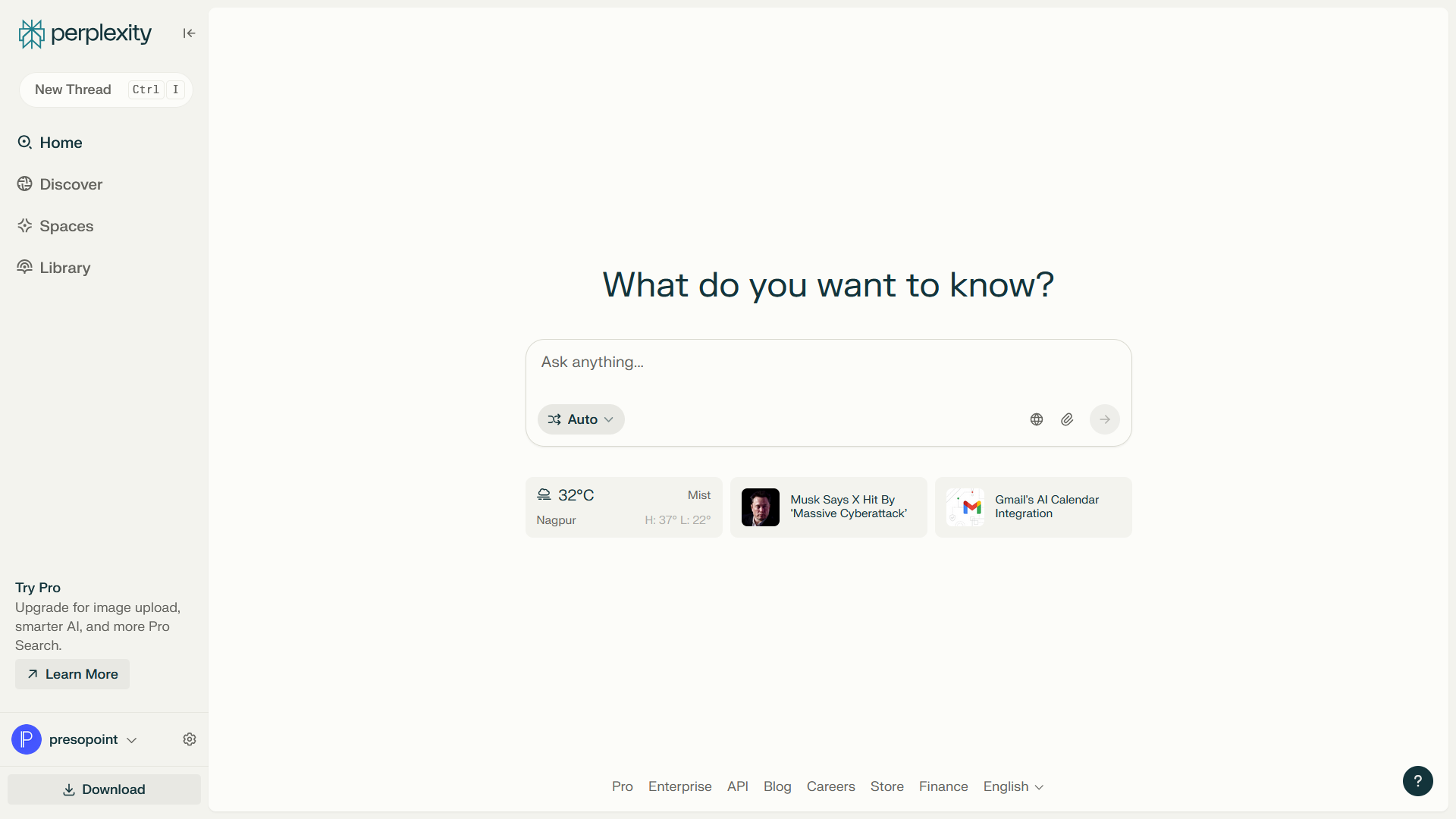
Screenshot of the Perplexity homepage via Wikimedia Commons (CC0).
Deep research in one thread
This is the capability that quietly became indispensable in 2026. Instead of fifteen open tabs, you ask one question and the tool reads dozens of sources, cross-checks them, and returns a structured report. OpenAI’s Deep Research (February 2025) and Perplexity’s research mode both do this, with runtimes measured in minutes rather than seconds (Wikipedia). The honest caveats: a synthesized report is only as good as the sources it found, summaries occasionally flatten disagreement, and the heavy modes burn paid credits quickly. Treat the output as a strong first draft of research, then spot-check the claims that matter. For product comparisons, literature sweeps, and market research, this workflow has replaced tab-hoarding in most of our own editorial research.
Browsing that works for you
Comet is the category’s most aggressive bet: a Chromium-based browser with an assistant that summarizes pages, drafts emails, and can carry out purchases (Wikipedia). It shipped for Windows and macOS in July 2025, became free to download that October, and reached Android and iOS by March 2026 (Wikipedia). The judgment here is simple: the browser is becoming the new search box. Google reached the same conclusion from the other direction by planting AI Mode inside Search, while Perplexity built search into a browser. One caution from the security world: researchers at LayerX Security documented a “CometJacking” attack vector and criticized how Perplexity handled the disclosure (Wikipedia). Any agent with browser access is a privileged tool — treat it accordingly.
Search inside your company
The enterprise story is where AI search stops being consumer novelty. Perplexity’s enterprise tier, launched in August 2026, connects internal documents so employee questions are answered from the company’s own knowledge base, with permission controls and data that stays inside the corporate VPC (our AI search war briefing). Google approaches from the opposite direction: Gemini can already reach into your docs, mail, and calendar. For teams, the pattern matters more than the individual products — internal knowledge is the next corpus AI search will index, and per-seat pricing is the cost of entry. Enterprise tiers are priced separately from consumer plans, so check official pricing pages.
On the go
Mobile and voice are the least glamorous but most used slice of the category. Perplexity Assistant and ChatGPT’s voice mode put the same cited-answer engine in your pocket, and the practical win is small questions answered while walking — transit times, store hours, quick facts — without opening a results page. The model quality matches desktop; the interface is just thinner.
Three directions worth watching
These are judgments, not predictions. The first is grounded in shipped products, the second in announced strategy, and the third is partly our own observation.
1. The subscription test. Perplexity’s February 2026 bet — no ads, pay for answers — is the cleanest experiment in the category, and the outcome is still open. Google has considered ads inside AI Mode (Wikipedia), and ChatGPT’s free tier remains ad-free for now. If Perplexity grows on subscriptions alone, expect rivals to follow; if it stalls, expect ads to return under another name.
2. The browser becomes the search box. Two companies reached the same conclusion from opposite directions: Google puts AI Mode in the search tab, Perplexity built Comet around the assistant. The ten-blue-links page is no longer the product — the answer is.
3. Citations become the currency. As AI answers replace link lists, being cited by an AI matters more than ranking. This is partly our own observation — we track how our content appears in AI answers — and partly speculation about where traffic will settle. Site owners should write for verifiability: named data, dated claims, clear sources.
| Direction | Status as of August 2026 | Our judgment |
|---|---|---|
| Subscription vs ads | Perplexity all-in on subscriptions (Feb 2026); Google still weighing ads in AI Mode | Unresolved; watch growth and publisher deals |
| Browser-based search | Comet on all major platforms; AI Mode tab inside Google Search | Real but early; habits take years to move |
| Citation economy | Publishers optimizing for AI visibility; no standard metrics yet | Genuine shift; measurement still immature |
Who should use what
- Students and researchers: Perplexity’s free tier still answers with sources, and the paid plan (around $20 a month — check the official site) removes the daily meter on pro searches. Our Perplexity vs ChatGPT comparison covers the choice in depth.
- Casual users: stay on free tiers. Google’s AI Mode and ChatGPT’s built-in search answer everyday questions without a subscription, and the quality gap with paid tools is smaller than the marketing suggests.
- Teams: Perplexity Enterprise is the obvious starting point for knowledge-heavy work, but only if your documents live somewhere it can index. Google Workspace shops should test Gemini first, since the integration is the product.
- Budget users: rotate the free tiers. Ask the same question in two engines and compare the sources; that habit is a free education in which one to trust.
FAQ
Can I still use Perplexity without paying?
Yes, but the free plan is deliberately limited since the February 2026 subscription-first shift: premium “pro search” queries are metered per day, while the base model answers without a daily cap. The paid plan is roughly $20 a month — verify on the official site.
Is AI search actually replacing Google?
Not in the sense of killing it — Google’s AI Overviews and AI Mode sit on top of its own index. What is changing is what “ranking” means. Being cited inside an AI answer is becoming more valuable than a top-ten link, which is why publishers now optimize for both.
Which AI search engine is most accurate?
There is no universal winner, and anyone who claims one is overselling. Perplexity is easiest to verify because it cites aggressively; ChatGPT and Gemini often give richer reasoning but bury sources. Accuracy tracks the sources the engine found, so spot-check the claims that matter.
Do I need an AI browser like Comet?
Only if you want search to act, not just answer — summarizing pages, drafting messages, completing purchases. For plain questions, a regular engine plus a chatbot covers the same ground without handing a browser agent your sessions.
Can AI search work on internal company documents?
Yes. Perplexity Enterprise (August 2026) and Gemini’s workspace integration both index internal knowledge; the former is built for it, the latter is a side effect of Google integration. Both charge per seat — check official pricing, since it differs from consumer plans.
Sources and notes
This overview was assembled in August 2026 from public, verifiable sources: Wikipedia (Perplexity AI, AI Overviews, Comet), The Verge (May 2025 and March 2026 coverage of Google AI Mode), MacRumors (Perplexity’s subscription-first transition, as cited by Wikipedia), and our own AI search war briefing. We have not run a formal lab test of these tools; pricing and features change quickly, so check official pages before paying. Our Perplexity tool page and Perplexity vs ChatGPT guide have more depth.